Navigation & Design Systems
Designing Career Pathways at Meta
Designed and shipped scalable navigation and page systems for Meta Careers; helping introduce a new "Pathways Program" initiative while extending Meta's existing design system across flexible, story-driven templates.
Shipped late 2021 / early 2022. Work shown reflects the experience prior to later Meta Careers redesigns.

Impact at a glance:
Shipped navigation architecture reflcted in Meta Careers evolution
Established clearer entry points into Meta's career pathway ecosystem
Reduced dependency on custom page creation through modular component strategy
Designed scalable templates supporting multiple program types and stories
Role
UX Designer
Led UX strategy, navigation architecture, and page system design for Meta Careers' new "Pathway Programs" initiative.
Responsibilities included:
navigation strategy and information architecture
UX exploration and interaction modeling
scalable template design using Meta's design system
wireframing and systems-based page composition
stakeholder presentations and iterative refinement
Opportunity
Meta Careers was introducing a new “Pathway Programs” initiative aimed at supporting multiple audience segments beyond traditional students and graduates.
The team faced two primary challenges:
determining where Pathway Programs should live within the existing careers navigation
designing flexible templates capable of supporting evolving storytelling needs across different programs
The work needed to:
align with existing navigation behaviors
leverage Meta’s established design system
scale without requiring custom page builds for each new initiative
Product Focus — Career Pathways
Designed a scalable navigation and content system helping users discover and explore Meta’s career development programs.
The experience included:
navigation entry points
landing page templates
detail page templates
reusable modular content structures
Problem Definition
Meta’s existing careers navigation had established interaction patterns and user expectations.
Introducing a new category into the ecosystem created several challenges:
determining the most intuitive navigational placement
balancing discoverability with simplicity
extending the navigation without disrupting existing behaviors
creating flexible templates using a constrained component library
The solution needed to feel native to Meta Careers while supporting future scalability.
Solution Overview
Designed a scalable pathway system consisting of:
integrated navigation architecture
modular landing page templates
flexible detail page templates
The system leveraged Meta’s existing design system and component library to:
maintain consistency across the Careers ecosystem
support evolving storytelling needs
reduce implementation complexity
enable reusable layouts across multiple programs
Experience Overview
The experience enables users to:
discover Pathway Programs through existing navigation structures
explore program categories and opportunities
navigate between overview and detail experiences
access relevant application and career entry points
Key Design Decisions
Navigation grounded in existing user behavior
Analyzed Meta Careers’ existing navigation patterns to ensure new functionality aligned with established mental models.
Embedded vs. standalone navigation exploration
Explored multiple navigational approaches balancing, discoverability, clarity, interaction complexity, and consistency with existing patterns
Design-system-first execution
Worked entirely within Meta’s existing design system and component library to ensure implementation efficiency and ecosystem consistency.
Modular page system architecture
Designed flexible templates capable of supporting multiple storytelling structures without requiring new page designs.
Nested navigation interaction model
Introduced a nested interaction approach to better group and distinguish Pathway Programs from existing content categories.
This provided:
stronger organizational clarity
dedicated exploration space for Pathway Programs
scalable expansion opportunities for future content
Navigation Exploration
Existing Navigation Analysis


Mapped existing navigation behaviors and interaction models to identify the most scalable placement opportunity for Pathways Programs.
Navigation Concept — Embedded Approach
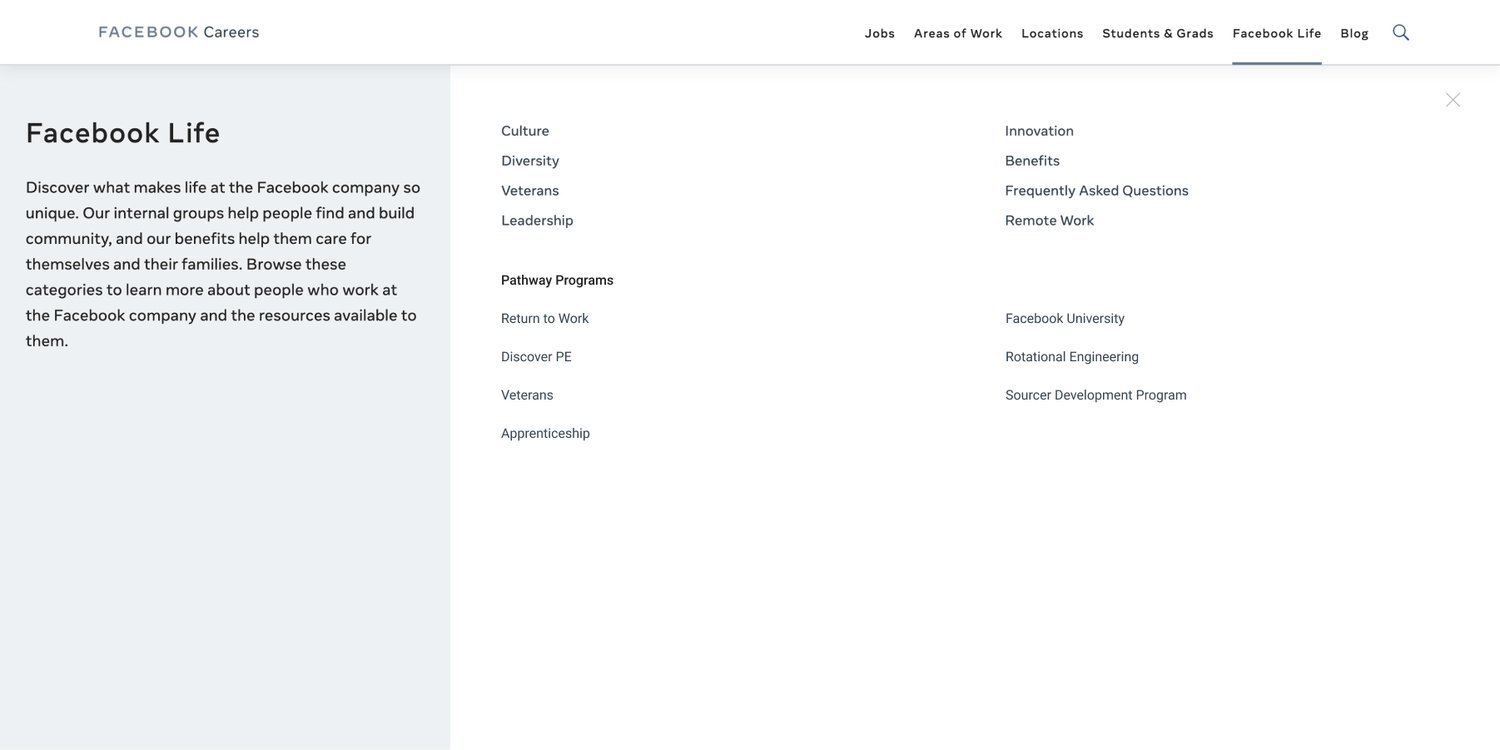
Explored integrating Pathway Programs directly within the existing Facebook Life navigation structure.
Benefits
Immediate visibility
Minimal interaction change
Lower learning curve
Tradeoffs
Reduced contextual clarity
Potential discoverability ambiguity
Navigation Concept — Nested Navigation

Explored a nested navigation interaction introducing a secondary exploration layer for Pathway Programs.
Benefits
Clearer grouping and hierarchy
Stronger distinction between content areas
Better scalability for future expansion
Tradeoffs
Introduced a new interaction behavior
Increased interaction depth
The nested navigation approach was ultimately selected and shipped.
Template System Design
Landing Page Template (wires, left | in-prod, right)

Designed to:
provide program overviews
surface exploration pathways
support flexible storytelling structures
Detail Page Template

Designed to:
support program-specific storytelling
highlight opportunities and application pathways
maintain flexibility through modular component composition
Considerations & Constraints
Limited timeline and budget prevented formal usability validation
Needed to work entirely within existing Meta component ecosystem
Navigation changes required balancing innovation with familiarity
Templates needed to support evolving program content over time
Research & Validation Considerations
While formal testing was constrained by timeline and budget, the proposed validation plan included:
usability testing
tree testing
navigation discoverability studies
A/B testing against existing navigation patterns
Design decisions were guided by:
existing platform behaviors
information architecture best practices
mental model consistency
Outcome
The nested navigation solution was selected and shipped as part of Meta Careers.
Following Meta’s broader Careers evolution, the organizational structure of the navigation evolved further, but the foundational interaction patterns and grouping concepts established during this work remained reflected in later implementations.
The modular page system also enabled scalable expansion of career pathway content without requiring custom page redesigns for each initiative.
Reflection
This project reinforced the importance of designing within established systems—balancing user expectations, scalability, and platform consistency while introducing entirely new content structures.
Rather than designing isolated pages, the challenge centered around extending an existing ecosystem in a way that felt intuitive, scalable, and native to the product.