
Information Architecture & Enterprise UX
Redesigning the Digital Experience for Ropes & Gray
Led UX strategy, information architecture, and wireframing for a full-scale redesign of the global law firm’s website; modernizing a decade-old experience and restructuring how clients, recruits, and prospects navigate complex legal content.
Final visual design completed by Myohan Oh and Collin Koetz. UX strategy, information architecture, and wireframes led by me.
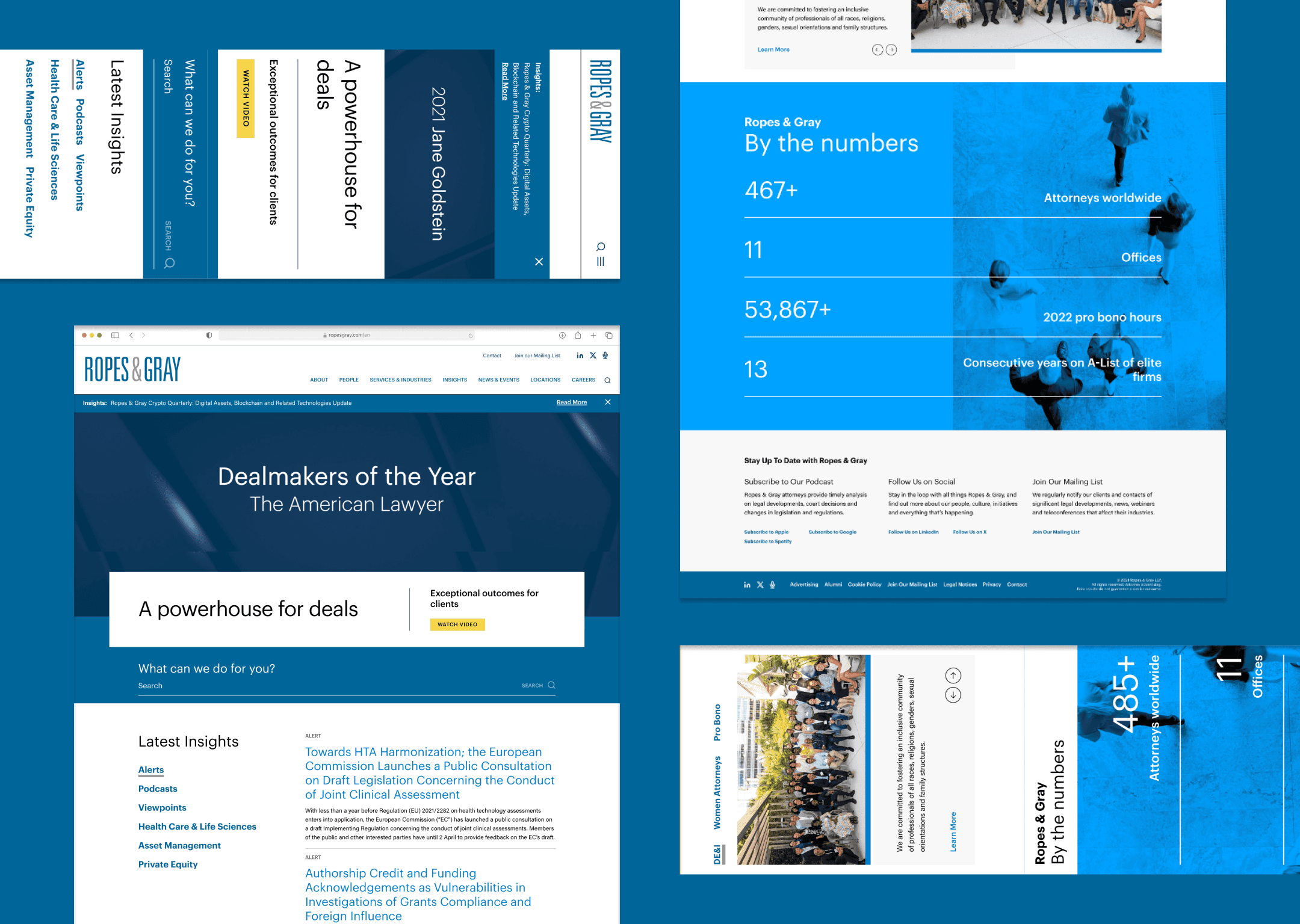
Impact at a glance:
Redesigned a 10+ year old enterprise website from the ground up
Developed a new information architecture supporting multiple user types and business goals
Created scalable wireframe systems across core site experiences and global components
Established strategic UX foundation for final visual design and implementation
Role
UX Designer
Led UX strategy and foundational experience design across Discovery and Define phases.
Responsibilities included:
site auditing
stakeholder interviews
persona development
information architecture strategy
wireframing across core site experiences
discovery synthesis and presentation readouts
Collaborated closely with strategists, stakeholders, and visual designers throughout the redesign process.
Opportunity
After more than a decade without a major redesign, Ropes & Gray sought to modernize its digital presence and rebuild the site from the ground up.
The existing experience faced challenges around:
outdated information architecture
fragmented navigation patterns
content discoverability
inconsistent user pathways across audiences
The redesign needed to better support:
prospective clients
current clients
lateral recruits
thought leadership discovery
global service and industry navigation
Product Focus — Enterprise Web Platform
Designed the UX foundation for a large-scale enterprise content platform serving multiple user groups across legal services, recruiting, insights, and firm information.
The redesign included:
global navigation systems
people directories
service and industry pages
insights and news experiences
recruiting and firm information pathways
search and location experiences
Problem Definition
The existing site had evolved over time without a cohesive structural strategy, leading to:
difficult navigation across large content sets
inconsistent user journeys
unclear prioritization of business objectives
challenges surfacing relevant expertise and insights
Additionally:
different user groups had overlapping but distinct needs
stakeholders across the firm had varying priorities for the redesign
the site needed to scale across a large and evolving content ecosystem
Solution Overview
Developed a new UX foundation centered around:
improved information architecture
scalable navigation systems
clearer content hierarchy
modular wireframe structures
The redesign focused on:
helping users find relevant expertise faster
improving cross-site discoverability
creating scalable page systems
modernizing the experience without disrupting core business workflows

Discovery & Research
Stakeholder Interviews
Conducted Partner interviews to better understand:
business priorities
audience behaviors
pain points within the existing experience
content and navigation challenges
While direct user interviews were limited, stakeholder conversations provided valuable insight into the behaviors and expectations of the site’s primary audiences.
Persona Development
Developed personas representing key audience groups:
prospective clients
current clients
lateral recruits
These personas informed:
navigation strategy
content prioritization
page hierarchy decisions
user flow considerations
Discovery Readout
Synthesized findings into a strategic Discovery readout presented to stakeholders, aligning the team around:
user needs
business priorities
opportunities for structural improvement
recommended next steps

Information Architecture
Developed a new information architecture designed to:
simplify navigation across complex legal content
improve discoverability of expertise and thought leadership
support multiple audience pathways
create clearer organizational hierarchy across the platform
Key considerations included:
balancing breadth of content with navigational simplicity
reducing redundancy across sections
supporting scalable future growth

Wireframing System
Once the proposed IA was approved, the project transitioned into defining scalable page structures and interaction patterns across the redesigned experience.
The wireframing process was organized into iterative sprints covering core platform areas.
Sprint 1 — Foundation & Navigation
Included:
Homepage
People Landing
People Detail
Global Navigation Components
Focused on:
establishing global interaction patterns
defining navigation hierarchy
surfacing expertise and firm credibility
Sprint 2 — Services & Insights
Included:
Services & Industries Landing
Service / Industry Detail
Insights & News Landing
Insights Detail Pages
Focused on:
improving content discoverability
structuring long-form editorial content
supporting cross-linking between expertise and insights
Sprint 3 — Supporting Experiences
Included:
General Content Pages
Locations Landing
Locations Detail
Site Search
Focused on:
scalability across lower-level templates
consistency across supporting experiences
improving search and location discoverability
Key Design Decisions
Audience-driven architecture
Structured the experience around distinct user groups rather than internal organizational structure.
Scalable navigation systems
Designed flexible navigation patterns capable of supporting a large and evolving content ecosystem.
Modular page frameworks
Created reusable wireframe systems that enabled consistency across services, insights, recruiting, and firm content.
Content discoverability
Prioritized surfacing expertise, thought leadership, and related content throughout the experience.
Enterprise scalability
Balanced modern UX patterns with the operational realities of managing a large-scale enterprise content platform


Considerations & Constraints
Large and complex content ecosystem
Multiple stakeholder groups with competing priorities
Limited direct end-user research access
Needed to modernize the experience without disrupting established user expectations
Required scalable frameworks capable of supporting future growth
Outcome
The project established a modernized UX foundation for Ropes & Gray’s digital ecosystem, improving:
content organization
navigational clarity
scalability across the platform
discoverability of expertise and insights
The redesign also created a reusable structural framework supporting long-term evolution of the site experience.
Reflection
This project reinforced the importance of information architecture and structural thinking in large-scale enterprise redesigns.
Rather than focusing solely on page-level interactions, the challenge centered around organizing complexity—creating a scalable system capable of supporting multiple audiences, business goals, and evolving content needs across the platform.